
Happy To Help
Issue 033

I’ve never been a big fan of Batman movies. Mostly because Batman strikes me as an arrogant rich man with unresolved issues who decided to replace therapy with an expensive hobby involving custom suits and loud cars. Cars he then destroys every ten minutes through reckless driving and unnecessary explosions, contributing to CO₂ emissions while pretending to save the city.
I’ve always found The Joker more relatable. Humble. Grounded. Deeply misunderstood. Constantly bullied by a man in painfully tight leather pants who’s apparently too cool to take the bus. In his position, I too would be frustrated. I too would consider setting the whole city on fire.
In the 2008 film The Dark Knight, The Joker delivers an iconic line: “If you’re good at something, never do it for free.” It resonated deeply with me and became a personal life motto.
Just the other day, while entering an U-Bahn station, a woman struggling with a baby stroller kindly asked if I could help her down the stairs. I remembered that I’m good at carrying things. So I suggested we schedule a call to discuss the scope of the task. After that, I’d send her a revised quote, payment terms, and a rough timeline. Then we could take it from there. That Joker was life-changing.
To be fair, when I’m not good at something, I do it for free. A friend once asked me to help mount an unnecessarily large TV to his living-room wall. I went over, we carefully took the wrong measurements, drilled with confidence, and installed the mount at a height calibrated to cause just the right amount of neck pain after fifteen minutes of watching. Shortly after I left, he sent me a photo of the other side of the wall we’d drilled. It now featured cracks and several pointy nails emerging. Obviously I did not invoice him.
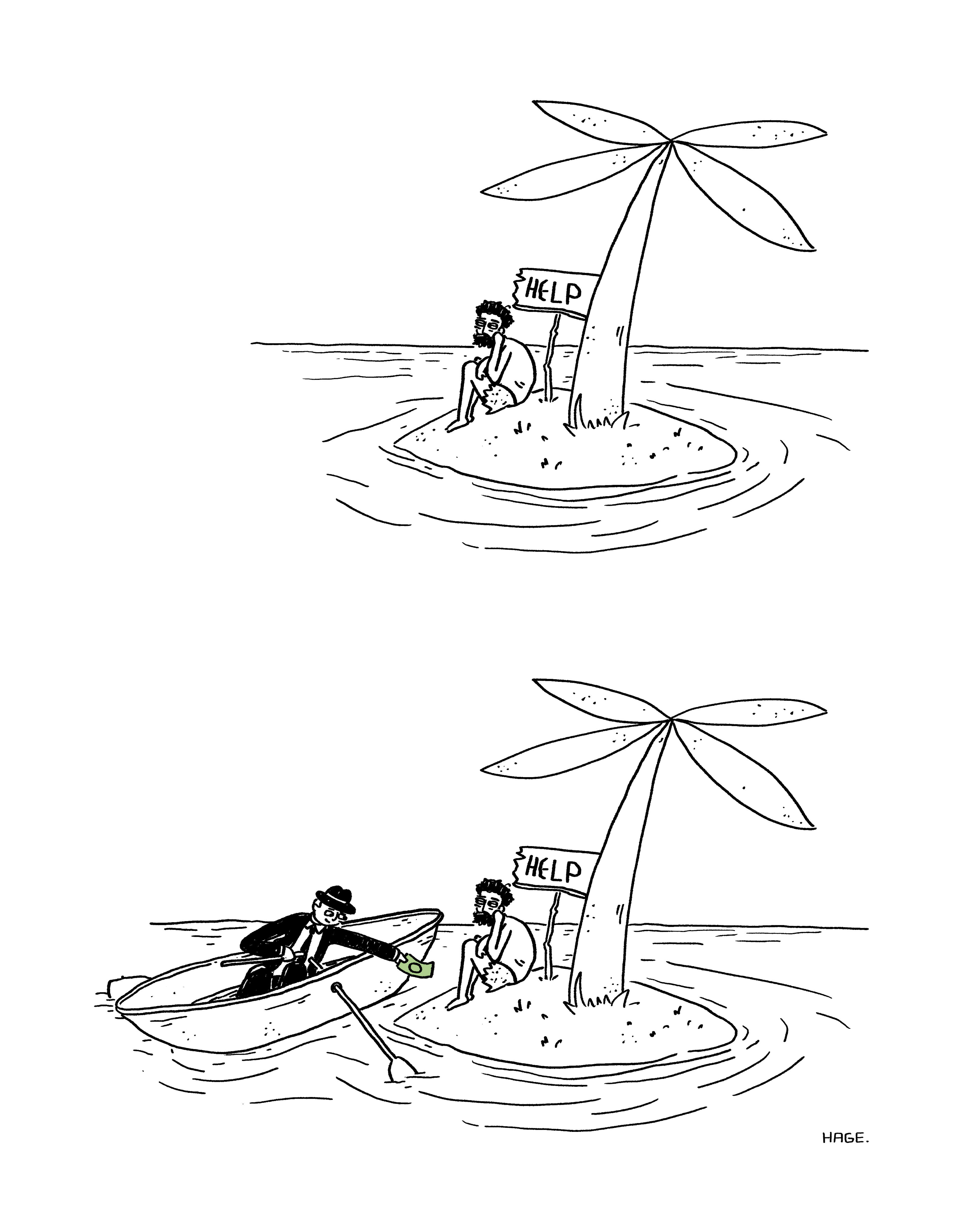
I often help others, though my generosity is selective. I’m not sure that qualifies me as a good person. If you’re my next-door neighbor, someone I like, and I see you hauling heavy grocery bags up the stairs, I’ll rush in without a second thought.
But if you’re my upstairs neighbor who starts stomping around at 5:30 in the morning and turns on the dishwasher at 5:45, conveniently located right above my bed, and I then see you struggling down the stairs with a heavy commode you’re throwing out, good day to you, sir. And please keep it down as you tumble down the stairs. I’m trying to meditate.
When someone asks me for money, whether I hand them a coin depends entirely on how I’m feeling about my finances that month. Never mind that the coin makes no measurable difference. It’s purely psychological. But I compensate for this moral ambiguity when people ask me for directions. Often old people. I stop, look up the destination on my phone, show them the map. Even if it means missing my train. Sometimes I walk them there, making small talk along the way. Asking how often they think about death. And whether they imagine theirs will be painful.
When I first arrived in Berlin, a friend gave me a crash course in German bureaucracy. She walked me through every step required to exist on paper. Finding a flat. Registering my address. Opening a bank account. Insurance. Phone contract. Taxes. The whole administrative pilgrimage. For someone who didn’t yet know where they were, or where to go, it was genuinely life-saving.
As a believer in good karma, I’ve since offered the same crash course to newcomers who approach me with questions. Few months back, someone who had just arrived in Berlin asked how to register as a freelance artist with the Ministry of Finance. I didn’t hesitate to help. It later turned out I’d accidentally sent him the wrong link. He appears to have registered in Liechtenstein. Due to paperwork complications, he eventually had to move and settle there. Every now and then he visits his wife and child in Berlin. Looking at the bright side, this taught me that sometimes, the most helpful thing you can do is stay out of it.
On a more serious note, I find real comfort in watching people help each other with small, ordinary things. Especially strangers. I can forget birthdays, conversations, even whole childhood chapters, but I never forget the face of a stranger who smiled at me. There’s something rewarding, sustaining about that. And if it’s within my power, I help.
Helping is nice because it’s voluntary. In theory. Unless you’re a child and your father asks if you can help with something. You recognize this as a trick question. The illusion of choice, the illusion of autonomy is presented. You realize that declining your father’s request will trigger an irreversible life trajectory involving hunger, educational collapse, couch surfing, substance abuse, small-scale crime, and eventually prison. So you help.
In 2005, when the Syrian army finally left Lebanon after nearly thirty years of occupation under the Assad regime, they also vacated our house in the village I’m from. I was seventeen. My father asked me to come with him to that house and “help out with a few things.” What follows is a true story about endurance, limits, and the price of being too helpful.
